On January 19, 2021, the European Chemicals Agency (ECHA) formally added the two newly reviewed substances to the list of SVHC candidate substances. So far, the SVHC candidate list includes 24 batches of 211 substances.
The information of 2 new SVHC candidate substances is as follows:
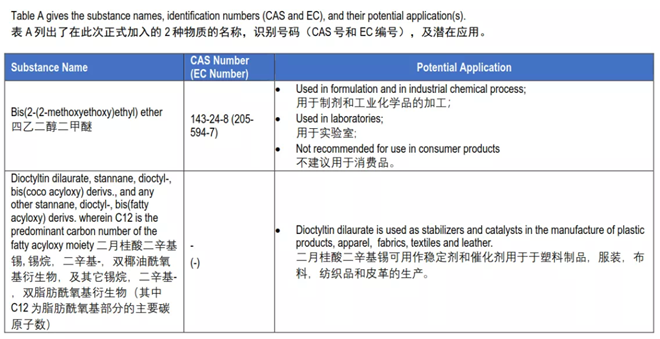
Examples of common uses
Substance 1: bis(2-(2-methoxyethoxy)ethyl) ether
Used in inks, toners, and production of plastic and rubber tires, used in flue gas cleaning systems, solvents for the production of paint binders, coagulants in paint formulations, adhesive production, electrodeposition, solder/solder paste production , Adsorption liquid gas washing, paint remover and degumming agent components, used to extract VOCs from solid waste, used to fix methylated methylol melamine resin in pressure-resistant cotton and fiber fabrics, inert additives, automotive air conditioning compressors HFC/CFC lubricants, lithium battery technology, promote selective adsorption of proteins in the cell adhesion process, and used as emulsifiers in inks.
Substance 2: Dioctyltin dilaurate, stannane, dioctyl-, bis(coco acyloxy) derivs., and any other stannane, dioctyl-, bis(fatty acyloxy) derivs. wherein C12 is the predominant carbon number of the fatty acyloxy moiety
Used in adhesives and sealants, coatings and paints, thinners, paint removers, fillers, putty, plaster, modeling clay, metal surface treatment products, non-metal surface treatment products, inks and toners, toners, pH adjusters , Flocculants, Precipitating Agents, Neutralizers, Leather Treatment Products, Paper Treatment Agents, Polishing Agents, Wax Mixtures, Polymer Preparations, Textile Dyes, Impregnation Products, Cleaning and Cleaning Products, Used in Plastic Products, Rubber.
According to REACH regulations:
a. If the product contains SVHC substances and the content is greater than 0.1%, and the annual production or import volume is less than 1 ton, the manufacturer should provide the item receiver with information to ensure the safe use of the item, including at least the chemical name; consumers may request the item SVHC information must be provided within 45 days.
b. If the product contains SVHC substance and the content is greater than 0.1%, and the annual production or import volume is greater than 1 ton, the article should be notified to the European Chemicals Agency (ECHA) (within 6 months after the announcement of SVHC): Contact Personal information, substance information, classification and labeling, use, tonnage, registration number (if any).
In addition, according to the newly revised EU "Waste Framework Directive" (WFD Directive, Directive 2008/98/EC), ECHA requires that from January 5, 2021, the SVHC content in articles placed on the EU market is greater than 0.1% , Regardless of whether its annual export volume exceeds 1 ton, it must submit a SCIP notification, and the supplier of the article must submit a SCIP notification to ECHA (European Chemicals Agency). The information must be submitted to the SCIP database, and the information will be posted on the Agency’s website later.
SCIP notification process
◆ Dossier preparation through IUCLID 6;
◆ Fill in online, fill in offline and upload again, and transmit through special software;
◆ File submission through ECHA submission portal;
◆ Obtain submission reports.
Information to be submitted for SCIP notification
◆ Item identification information (including item name, item identification code, item category, whether it is produced in the EU, etc.);
◆ Safe use information: including safe use instructions, for complex products, it also involves disassembly instructions and waste disposal instructions;
◆ Provide information on SVHC candidate substances with a concentration exceeding 0.1% (including the name of the SVHC candidate substance, the concentration calculated based on simple items, and the quantity contained in the product).
Reminder:
With the continuous update of the SVHC candidate list, companies are facing more and more control requirements. ZRLK recommends that relevant companies increase their risk awareness of their products, investigate the supply chain as early as possible, and pay attention to the updates of REACH regulations in a timely manner to calmly respond to changes in regulations.